The Regret Calculator
A financial engineering tool that quantifies the true cost of everyday spending habits using custom compound interest algorithms and real-time market data. 9,960+ decisions analyzed across 42 countries, with a full infrastructure stack running behind it.

About the Project
The Regret Calculator is a financial engineering tool built around one uncomfortable question: what has your spending actually cost you? Not the dollars you spent today, but the compounded wealth you never built. It converts everyday habits and recurring subscriptions into a precise future-value number tied to real market-rate growth, making the invisible math of opportunity cost impossible to dismiss.
Built by Sepehr Zunoubi, NYU Stern Breakthrough Scholar and founder of Compound Labs, the project has already analyzed over 9,960 financial decisions across 42 countries, surfaced more than 960 million dollars in total capital wasted, and shown users an average of 667% in annual yield missed. As of right now, it sits fewer than 40 decisions away from the 10,000 milestone.
The Problem
Worth Solving
Most consumers see a $20 monthly subscription as a rounding error. The Regret Calculator applies a standard 7 to 10 percent market return to show what that actually means over a career. That $20 is not $240 per year. Over 30 years at market returns, it is more than $15,000 in lost wealth. The project calls this the Invisible Math of Opportunity Cost, and that calculation is the engine behind every result the tool produces.
Step 1: Enter Your Bad Decisions
The calculator opens with an input table. Each row takes three values: an expense name (Spotify, gym membership, takeout, anything), a dollar amount, and a frequency selection of daily, weekly, monthly, or annual. You can stack as many rows as you want. There is a Quick Load button that populates a realistic sample dataset instantly, so you can explore the tool without typing anything.
An Assumptions panel sits alongside the inputs. It controls the Expected Annual Return via slider (default 10%), the investment horizon in years (default 30), and an inflation-adjustment toggle for real-value calculations. You also pick your benchmark: compare your results against the S&P 500 historical CAGR, or enter a fully custom return rate. Every change to the assumptions panel updates the output without re-submitting.
Step 2: The Results Panel
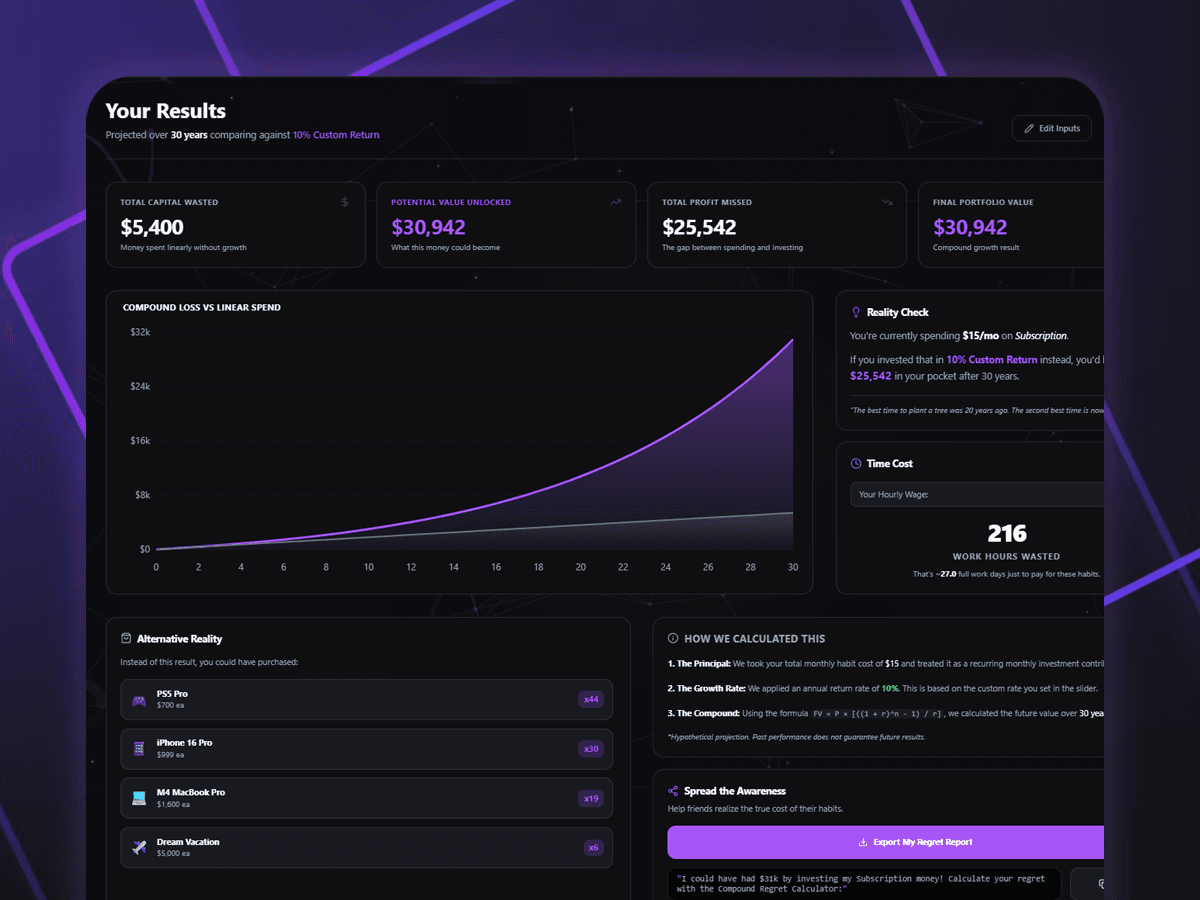
After clicking Analyze, three headline numbers appear: Total Capital Wasted (the raw sum you spent), Potential Value Unlocked (what that money would have compounded to), and Total Profit Missed (the gap between the two). Below those, a compound growth chart plots your linear spending against the compound growth curve over the full investment horizon. The visual divergence between those two lines is usually the moment the tool lands.
The Alternative Reality section translates the abstract dollar gap into physical things: what your compounded loss could have bought. Results surface real options like a PS5 Pro, iPhone 16 Pro, a MacBook, or a dream vacation, benchmarked against your specific number. It is the most-shared section of the output because it makes the math personal and concrete in a way that percentage points simply do not.
Tech Stack
The frontend is built with React 18 and TypeScript, compiled with Vite. This means full static type safety across every component, fast hot-module replacement during development, and optimized production bundles on deploy. The project follows a clean separation of concerns with dedicated directories for components, hooks, lib, and utils. The repository sits at 55 commits across the main branch with active weekly development.
Styling is handled with Tailwind CSS using a mobile-first approach. The v2.0.0 update shipped a full mobile navigation with a 3-step wizard, the Sovereign Snow particle effect, a simplified theme system, and smoother animations throughout. The app supports three color themes controlled entirely through CSS custom properties: Purple (default), Green, and Blue, making it trivial to swap the accent system without touching component code.
Real-time data syncing is handled by Firebase Realtime DB. The global counters for decisions analyzed and total capital wasted are written to Firebase on every calculation, with race condition handling in the hooks layer to prevent double-counting under concurrent writes. The S&P 500 Data Feed and Real-Time Market Data services feed directly into the benchmark comparison engine and are shown as live in the system status panel.
Infrastructure
Deployment runs on Vercel with web servers in US-East and EU-West regions and a dedicated CDN for asset delivery. The public Roadmap page exposes a live system status panel showing every service in real time: Backend API, Database Primary and Replica, Firebase Realtime DB, Compound Engine v2, Opportunity Cost Model, Auth and Session Tokens, S&P 500 Data Feed, Real-Time Market Data, and Analytics Pipeline. The compound interest engine itself uses the future value formula FV = P x ((1+r)^n - 1) / r, layered with optional inflation deflation to give users real purchasing-power numbers alongside nominal figures.
Version History
The project launched with v1.0.0, the Genesis Update, in May 2025. v1.2.0 followed in June 2025 with a Theming and Export Update. v2.0.0, called the Mobile and Retirement Update, shipped in June 2025 as the largest release to date. It added the Retirement Freedom Bridge (a Time-to-$1M Calculator), full mobile navigation with a 3-step wizard, the Sovereign Snow particle effect, the Investment Strategy Selector with real return data, and a polished Head-to-Head Battle comparison UI.
What’s Next
v3.0, called The Social Compound, is currently in progress. v4.0, Automated Reality, is queued behind it. The public Roadmap page tracks every shipped and planned feature alongside a live system status panel that reflects the health of every infrastructure service in real time. The Regret Calculator is not a side project with a single screen. It is a growing financial platform with a defined release cadence, real infrastructure, and a clear thesis it is still proving out.
